
Spring Valley gets most of its rain between November and March, often in a few short, heavy storms. On a landscape of hills and canyons, that water does not soak in. It runs downhill, toward the lowest door.
Key takeaways
- Most Spring Valley rain falls from November to March, often in short heavy winter storms called atmospheric rivers.
- Canyon and hillside runoff around Dictionary Hill and Mount Helix follows the slope toward garages, patios and lower rooms.
- A January 2024 storm flooded neighborhoods across San Diego, and the January 22 storm stalled over Spring Valley and Lemon Grove.
- Runoff carries mud and contamination, so cleanup includes mud-out, extraction, removal of wet porous materials and drying.
- Preparing before the wet season is cheaper than cleaning up after it.
How hillside runoff reaches a Spring Valley house
Spring Valley is an unincorporated community in San Diego County with a semi-arid Mediterranean climate. The summers are dry, and the ground is hard and dry when the winter storms arrive.
Hard, dry ground absorbs little. When a heavy storm drops rain quickly, runoff pours off the slopes around Dictionary Hill and Mount Helix and through the canyons below.
Many homes stand on graded hillside pads with retaining walls. Water that collects behind or above those pads finds its way to doors, garages and low rooms.
What the January 2024 storm showed
In January 2024 a historic storm flooded neighborhoods across San Diego. On January 22, a storm stalled over South San Diego, Lemon Grove, Spring Valley and South La Mesa, and the day ranked as the fifth wettest ever recorded in the region.
Nearby Lemon Grove saw sinkholes, and part of Federal Boulevard turned into a river. Spring Valley sits right beside Lemon Grove, and the same weather system affected both.
The lesson for homeowners is that a single storm can do real damage in a day, even in a dry climate.
Where the water gets in
Runoff rarely comes through the roof. It enters at ground level, and the weak points are predictable.
- The garage door threshold, especially on a sloped driveway.
- Sliding doors and patio doors that sit low to the ground.
- Gaps where a retaining wall meets the house.
- Window wells and low vents.
- Floor drains that back up when the storm drain is full.
What to do when water is coming in
Safety first. Fast-moving water, mud and electricity are a dangerous mix.
Once it is safe, a storm runoff flood cleanup crew can start the work.
- Stay out of moving water and avoid driving through flooded roads.
- Keep away from wet rooms if the power is on, and turn off the main breaker only if it is dry and reachable.
- Lift valuables, papers and electronics off the floor.
- Photograph the water line and the damage before moving anything.
- Keep children and pets out of the mud and standing water.
Mud-out, extraction and cleaning
Runoff leaves more than water. It leaves silt, leaves and contamination from the yard and the street, and that makes it a cleaning job as well as a drying job.
Extraction and mud-out
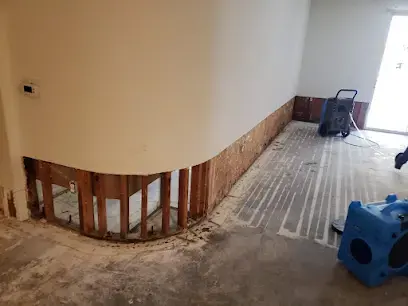
The crew first pumps or extracts the standing water. Then the mud is shoveled and washed out of the garage, the low rooms and from under cabinets, before it can harden.
Doing the mud-out early makes drying much easier.
What comes out and what stays
Porous materials that soaked in runoff are removed because they cannot be made clean again.
- Carpet, padding and soaked drywall.
- Insulation in wet wall bases.
- Cardboard, fabric and particle board items.
- Hard surfaces, framing and slab are scrubbed, disinfected and dried.
Drying the lower rooms
Once the debris is gone, the drying team places air movers and dehumidifiers and checks meter readings of the slab edge, the wall bases and any wood floors.
Homes with raised foundations need the crawlspace checked too, because water can collect under the floor. The drying continues until the readings match the dry goal.
A garage that took water often shares a wall with the house, so that wall is checked on every visit.
Homes on raised foundations and slabs
Most Spring Valley houses sit on a slab, but some have raised foundations with a crawlspace. The two react to runoff in different ways.
On a slab, water pools on the concrete and wicks into the wall bases and flooring. On a raised foundation, water can collect in the crawlspace under the floor, where it is out of sight.
Either way, the crew checks the wall bases and the floor system with meters before deciding what has to come out.
- Slab homes: extract water, mud-out, then dry the wall bases and flooring.
- Raised foundation homes: check the crawlspace, pump any standing water and dry the framing.
- Garages: dry the shared wall with the house first.
Why timing matters after a storm
The hours after a storm are the cheapest time to act. Silt is still soft, wet materials have not soured and the drying equipment has more to work with.
Waiting lets mud harden, lets wood floors cup and gives mold a chance to start. A call on the first day keeps the loss smaller and the drying shorter.
Roads may be wet or closed for a while, so patience with scheduling is normal after a regional storm. Documenting the damage in the meantime helps.
Getting ready before the wet season
October is a good time to walk the property. A few small jobs can keep runoff from reaching the house.
A leaking sprinkler can add to the problem, as covered in the post on sprinkler leaks on sloped lots.
- Clear leaves from gutters, downspouts and yard drains.
- Check that water from downspouts is carried away from the foundation.
- Look at the drainage behind retaining walls.
- Know where the garage threshold and low doors are weak, and seal them.
- Keep stored items in the garage off the floor.
- Save the contact information of a restoration team before the first storm.