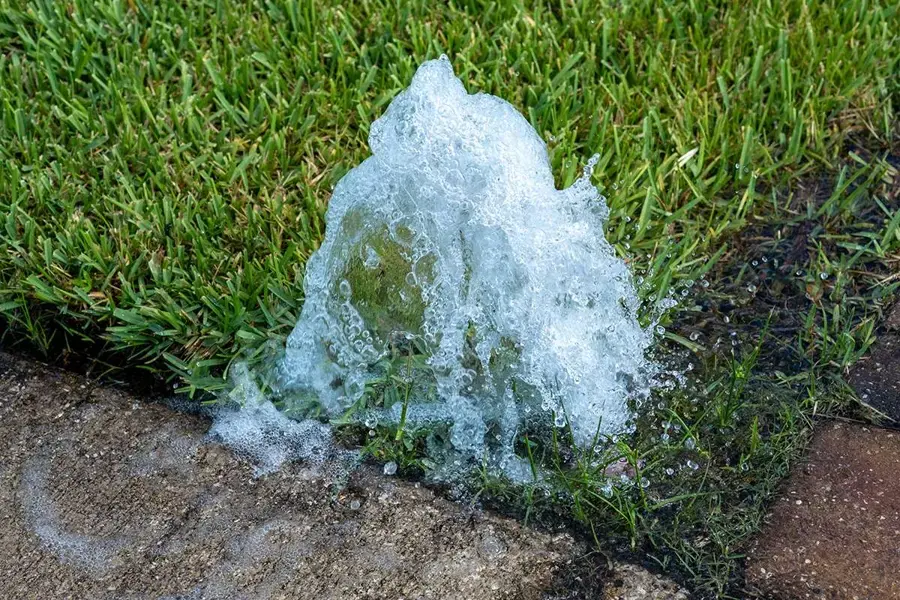
Spring Valley has dry summers and very little rain for most of the year, so sprinklers run for months at a time. On a sloped lot, one broken pipe or a valve stuck open can quietly steer that water toward the house.
Key takeaways
- Irrigation damage starts outside, but the loss shows up in the garage, the slab edge and the lowest walls.
- Many Spring Valley homes sit on graded hillside pads, so water from a leak follows the slope toward the foundation.
- A soggy strip of lawn on a dry day, a sprinkler zone that never shuts off or a wet garage floor are the early signs.
- Shut off the irrigation controller and the valve first, then document the water before anything is moved.
- Extraction pulls the standing water out, and drying finishes the walls, baseboards and slab edge.
Why sprinkler leaks matter on a hillside pad
Much of Spring Valley is built on graded hillside pads, often held back by retaining walls. The ground slopes, and water always takes the downhill route.
A sprinkler pipe that breaks on the uphill side of a house does not simply puddle in the yard. It travels along the soil, finds the foundation and pushes against the garage door threshold or the slab edge.
Because the dry season is long, irrigation is running when the owner is at work or asleep. A leak can go for hours before anyone sees it.
How a sprinkler failure sends water into the house
Irrigation systems fail in a few ways, and each one pushes water toward a different part of the house.
A cracked or cut pipe
A pipe can be nicked by a shovel, crushed by a vehicle on the driveway edge or split by age. The break sprays or seeps under pressure whenever the zone runs.
On a slope, that water collects against a retaining wall or flows to the lowest door of the house.
A valve stuck open
A valve that sticks open keeps a zone running long after the timer says stop. The ground saturates, and the extra water has to go somewhere.
Valves near a foundation are the most worrying, because the water is already close to the house.
A drip or spray head right at the wall
A head that has shifted can spray directly at stucco, siding or a garage door every morning. The damage builds slowly, so it often goes unnoticed until the baseboards swell.
Early signs a sprinkler leak is reaching the house
Most owners notice the garage first, because it sits at the low end of the slope and has the thinnest threshold seal.
- A dark, wet strip of soil or grass along the foundation on a day when the sprinklers are off.
- Water or a damp line along the bottom of the garage door and the garage floor.
- Mud or washed-out soil at the base of a retaining wall.
- A zone that sounds like it is running when the controller shows it off.
- Stained stucco or paint bubbling at the bottom of an exterior wall.
- A musty smell in the garage or in the room beside it.
What to do in the first hour
Stopping the water source comes before any cleanup. Then the evidence has to be kept.
A local irrigation leak water damage crew can take over once the flow has stopped.
- Switch the irrigation controller to off and close the irrigation shutoff valve.
- If water is entering the garage, lift boxes and stored items off the floor.
- Photograph the wet soil, the broken pipe or head, and the water in the garage.
- Move vehicles out of the garage if the floor is wet and there is a drain path to clear.
- Do not use a household vacuum on standing water.
Pulling the water out of a garage or room
Standing water in a garage is the part most owners can see, so it is the part that gets attention first.
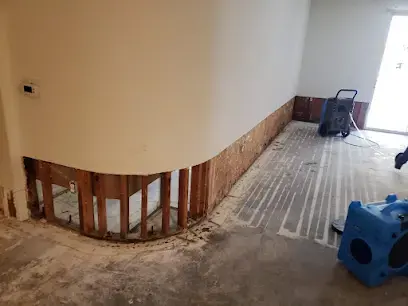
The water extraction crew uses truck-mounted equipment and wands to pull water from the slab, the baseboards and the carpet if the water reached a room.
Extraction matters because water that sits on the slab keeps wicking upward into wall bases and stored cardboard.
A garage that is attached to the house is the most important area to dry quickly, since moisture can travel through shared walls into living space.
What to expect from the restoration visit
The first visit is about measuring. The crew checks the garage floor, the lowest walls and the slab edge with meters, and notes how far the water traveled.
A written plan follows: what is extracted, what is opened, how many fans and dehumidifiers are needed and how often readings are taken. The water damage cost calculator gives a rough sense of the range before a plan is in hand.
Owners are usually asked to clear the garage floor and keep the irrigation off until the pipe or valve is repaired.
Drying the walls, baseboards and slab edge
Once the standing water is out, the drying team checks the lowest part of every wet wall and the slab edge with moisture meters.
Drywall that has wicked up the water is cut back as needed so air can reach the studs. Dehumidifiers and air movers then run until the readings match the dry goal.
If a retaining wall has been soaked, the crew may recommend a follow-up visit, because soil next to the house can hold water and slowly feed the wall bases.
- Baseboards come off so air can flow behind them.
- Wet insulation inside a garage wall is removed and replaced.
- Readings are repeated on each visit until the wall and slab edge are dry.
Checks that help prevent a repeat
After a leak, a walk around the yard on a dry day can catch the next problem before it reaches the foundation.
Run each zone for a short test and watch for geysers, soggy patches or heads aimed at the wall. Replace broken heads and pipe sections promptly, and keep an eye on the area around retaining walls.
If a zone runs long every week, a valve may be sticking. Fixing it early costs less than drying a garage.